High quality tools for innate immunity research and drug discovery

Explore the world of Drug Discovery with our ready-to-go project kits!
Are you a BSc or MSc student looking to gain hands-on experience with a meaningful research project in the Life Sciences? Or analyse data-sets from real world drug discovery programmes?
Our kits and associated resources enable you to perform laboratory (“wet”) and computer-based ( “dry”) projects in Drug Discovery at BSc and MSc research project level.
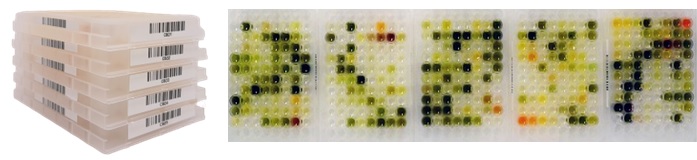
Shown below is the Phytotitre collection of traditional herb and medicine extracts, which we offer as an easy to use, ready made kit for student projects in drug-discovery.
Discuss possible project options with your supervisor
If you are interested in using our kits or online resources as part of your project, the first step is to discuss the possibilities with your supervisor. If they agree that using our resources may be helpful for your project, they will then be able to purchase one of our Phytotitre kits on your behalf.
What we offer
The Phytotitre collection comprises 400 extracts of traditional herbs and medicines. Students can screen the collection to seek novel drug leads, gaining valuable practical experience of early stage drug discovery.
Our kits are supported by comprehensive online project outlines and method sheets, giving you the step-by-step instructions necessary to complete a project from start to finish. Alternatively, our project outlines can also be easily modified to create your own bespoke project.
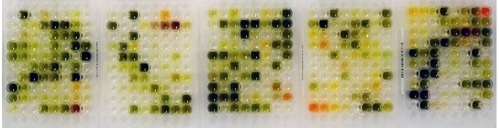
The Phytotitre natural product library
• 400 natural extracts in 96-well plate format
• Easy to use in student research projects
• Extensive online support for students
• Free project outlines and resources for supervisors
What types of project do your kits support?
Our online method sheets and project guides support you in either laboratory-based (“wet”) or computer-based (“dry”), drug discovery projects. The section below lists some broad project areas that are supported by our kits, online methods and other resources.
Shown below are some examples of possible projects which are backed by our comprehensive online method sheets and project guides. Click on the individual links to learn more about the options and outlines for each project.
• Aim to discover novel antibiotics, bacteriostatic agents, or enhancers of existing antibiotics.

• Aim to discover novel agents capable of inhibiting tumour cell-line growth, or enhancing the effects of existing chemotherapy drugs.
• Aim to discover novel inhibitors or activators of enzymes of interest.
• Aim to discover novel modulators of inflammatory cytokine release from cultured macrophages.

We also offer free access to datasets from our own internal screening campaigns. These make excellent “dry” computer-based projects for students interested in drug discovery, pharmacology, chemoinformatics, data science or statistics.
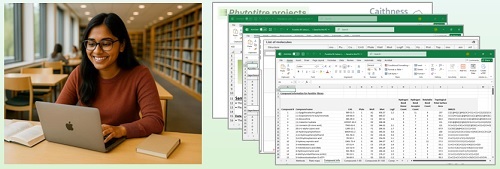
Key properties of our open access data-sets
• Authentic, unpublished screening data
• Suitable for BSc or MSc “dry” research projects
• Available for immediate download, no registration or purchase necessary
• Structured guides for data analysis and ideas for research questions are also available, free to download
Examples of suitable “dry” projects
Choose one of our data analysis project options to gain experience in the handling of large primary screening data sets, defining "hits" and identifying bioactive extracts or compounds, calculation of assay Z prime factor, correlation analyses and other statistical approaches. Shown below are some examples of possible dry projects which are backed by our comprehensive method sheets and project guides. Click on the individual links to learn more about the options and outlines for each project.
• Analyse data from screens of our Phytotitre 800 extract library to discover inhibitors of growth of E. coli or S. aureus bacteria.
• Analyse data from screens of our Puretitre 200 compound library to discover inhibitors of growth of E. coli or M. luteus. bacteria
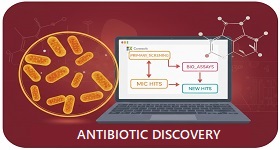
• Analyse data from screens of our Phytotitre 800 extract library to discover inhibitors of growth of the tumour cell-lines: MCF-7, PC3, HepG2 and A2780.

Supplementing or extending literature (library) projects
Our data projects also connect well to library projects. For example, the data analysis component could be expanded by exploring the literature for previous reports of other properties of the hit plants or compounds that may shed light on their bioactivity or potential for translation. Compound structure files for the Puretitre screens are supplied in SDF and XLS format, enabling further extensions to projects, for example through seeking correlations between bioactivities and physicochemical data of individual compounds.
A list of files and other resources supporting our educational content is available at the File Downloads page.
Where would I do the laboratory project?
The projects would be completed in your own university laboratories under the supervision of your university project supervisor.
What support is available to help me complete my project?
Our online project guides offer suggestions for suitable hypotheses to test, and research questions to address, during your project. A list of specific methods you should follow to complete each project variation is also given. Individual method sheets give step-by-step instructions on how to perform each experiment or stage of the analysis. Working through these method sheets in the order given in the project guide will help you to answer a specific research question. Please visit the individual project pages linked above to see examples of how the guides and method sheets support individual projects. Day to day support is from your university project supervisor.
How long does each project take?
This is very flexible and can be decided between you and your supervisor. The outlines we offer include many possible options for each project. A basic project can be completed in 8 weeks or less. Adding more experiments or analytical approaches can take the project up to 8 months or more.
Can I use the kits to study targets not listed in your methods or guides?
Certainly! The methods can be easily modified with help from your project supervisor to fit whichever target is most relevant to your shared interests.
How much does each kit cost?
Please visit this page for a current price list.
Where can I find further technical information on the Phytititre library?
More detailed technical information on the library properties is available here.
Do I have to buy any products to be able to use the screening data or “dry” project materials?
No, these are available to download free of charge from our website without requirement for purchase or registration.
Cam I buy larger quantities of individual extracts to further study them?
Yes, we can supply larger quantities of fresh extracts with a prompt turnaround. Please click here to view a current price list.
What are the advantages of focussing on natural products for drug discovery?
Natural products have historically been a highly successful source of new drugs (e.g. most antibiotics, many anti-cancer agents, statins, blood pressure drugs etc.). By focusing on plants with a history of oral use in man, the Phytotitre collection furthermore aims to maximise the chances of discovering drug leads which are both bioactive against a relevant target and of low toxicity.
Do you offer any pure compound collections?
Yes, our Puretitre collection of 200 natural compounds is also available in a similar format and is suitable for use in student projects in the same way.